How Ukrainian cities are building a path to climate neutrality together with Europe: Ukraine’s success story of the U_CAN project
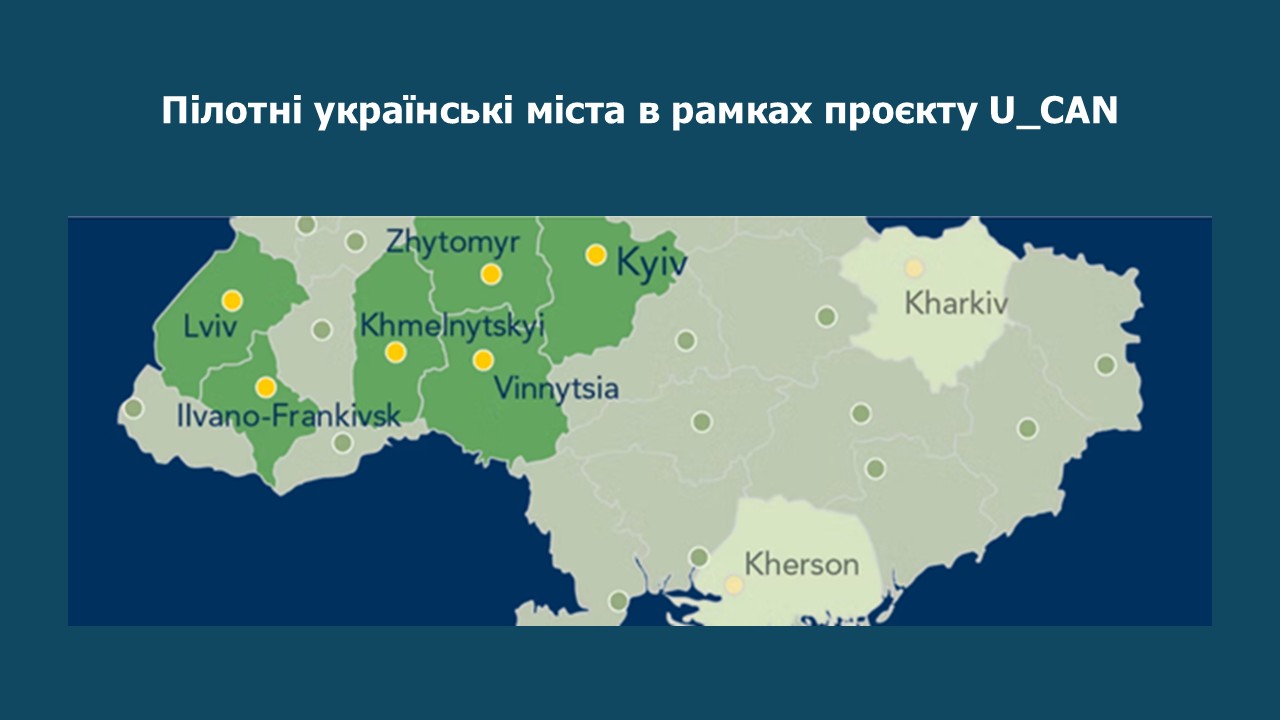
At a time when Ukraine is overcoming the unprecedented challenges of war, participation in international scientific and innovative initiatives is gaining strategic importance. One of the most striking examples was the large-scale Ukrainian participation in Ukraine towards Carbon Neutrality (U_CAN) project within the Horizon Europe EU Mission “Climate-Neutral and Smart Cities”. Nine Ukrainian universities, municipal and public organisations, as well as eight cities, joined the consortium at once, which became pilot sites for the implementation of climate-neutral solutions. Such a powerful representation shows that Ukraine is not only integrating into European research processes but also forming a common European path to climate neutrality.
Among the Ukrainian participants are the National Technical University of Ukraine “Igor Sikorsky Kyiv Polytechnic Institute” (KPI), NGO “Bureau of Research, Innovation and Technologies”, Kharkiv National University of Urban Economy named after. O. Beketova, NGO Club of Mayors, City Institute (Lviv), Zhytomyr City Council City Development Agency, Khmelnytskyi National University, Khmelnytskyi University of Management and Law named after Leonid Yuzkova, City Development Institute (Vinnytsia), NGO Regional Center for Sustainable Development. Together, they form a unique network of cooperation between academia, municipalities and civil society.
How the idea came about
They learned about the Horizon Europe Programme thanks to the international contacts of the KPI, previous projects on sustainable development and the work of the National Contact Points. As Oksana Vovk, Professor of the Department of Geoengineering, Director of the National Institute of Energy Saving and Energy Management of KPI, who is the head of the Ukrainian part of the project, coordinating work from KPI and interacting with Ukrainian municipalities, notes:
“An important role was played by the work of the NCPs, which disseminated information about the possibilities of the Programme. I would especially like to note the active support of the Department of International Cooperation of KPI, under the leadership of the Vice-Rector for International Relations, Candidate of Economic Sciences Andrii Shysholin, thanks to whose help, consultations and strategic vision, managed to navigate the requirements of the Programme in a timely manner, find potential partners and understand the opportunities for participation for our university. Such interinstitutional cooperation greatly facilitated preparation and allowed successful inclusion in the European research area”.
From Horizon 2020 to Horizon Europe
KPI has a long experience of participating in EU programmes, including Horizon 2020. This allows both to accumulate the reputational capital of KPI as a partner institution, and to contribute to the development of the competencies of employees of the educational institution who participate in the implementation of projects. So, for example, participation in international projects related to sustainable development and energy efficiency became a strong basis for successful participation in Horizon Europe.
The essence of the project
U_CAN brings together European and Ukrainian cities to work together on decarbonisation and increasing climate resilience. The German city of Dresden acts as a “beacon city”, passing on the experience of integrating climate solutions. The project started with eight pilot cities, which, together with the German “beacon city”, are testing new solutions in accordance with the principles of the European Green Deal. A key feature of the – bottom-up approach: solutions are formed in the cooperation of cities, universities, public organisations and citizens.
For four years, partners have been developing practical scenarios for cities, conducting workshops, dialogues with stakeholders, and creating manuals and training programmes. This ensures not only the adaptation of European standards to Ukrainian realities but also forms sustainable partnerships between cities in Ukraine and the EU. As a result, U_CAN integrates Ukrainian communities into the common vision of the European Green Deal, providing a real impact on the quality of life – from small towns to the capital.
Real influence for Ukraine
Thanks to U_CAN, Ukrainian cities get the opportunity to implement European standards in the field of climate neutrality: reducing emissions, developing ecological transport, increasing energy efficiency and restoring natural resources. This proves that even in wartime conditions, Ukrainian communities are able to implement innovative sustainable development practices together with European partners.
The KPI implements the key tasks of the Ukrainian part of the consortium. The university team is developing a Guide to Urban Climate Neutrality, organising a webinar on decarbonising the energy sector, integrating climate neutrality topics into curricula, and conducting policy dialogues with mayors and ministry representatives to disseminate results nationally.
“The main result was the inclusion of Ukraine in the European context of climate-neutral cities and a demonstration of the readiness of our communities to move towards sustainable development. We were able to show that Ukrainian cities are actively working on the implementation of decarbonisation and energy efficiency practices, focusing on the best European standards. The most important strategic goal was and remains to achieve full climate neutrality of Ukraine, which is an integral step on the way to integration into the European Union”, – Oksana Vovk emphasises.
Challenges and sustainability
Despite the difficult context of today, Ukrainian participants showed high organisational capacity. The support of the international department of KPI, experienced coordination by the Technical University of Dresden and consultations of the NCP helped to overcome bureaucratic barriers and ensure the coordinated work of the consortium. Special mention should be made of the coordinators from Technische Universität Dresden – Shanmathi Rajkumar and Swati Kulashri, thanks to whom it was possible to quickly establish an effective work process, coordinate tasks between all partners and ensure continuous exchange of information.
Advice to other organisations
“I would advise you not to be afraid of the complexity of the process and try. It is important to find strong partners and to articulate one’s own contribution. Participation in the Horizon Europe Programme opens up huge opportunities not only for science, but also for the development of communities and business”, – emphasises Professor Vovk.
An outlook into the future
U_CAN is a launching pad for new Ukrainian initiatives in the field of renewable energy, digitalisation of energy systems and sustainable urban planning. Ahead – scaling of developed solutions and their integration into national policies. This project already today consolidates the role of Ukraine as an active participant in the European green transition and a reliable partner in the field of climate neutrality.