



LUKE Project Newsletter (June 2026)
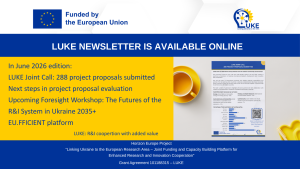
The LUKE project is releasing its 6th Newsletter Edition, designed to keep you informed about the latest developments and upcoming opportunities within our project.
Dear Readers and Partners,
On behalf of the Austrian Science Fund (FWF), I would like to welcome you to this newsletter!
One of the key projects of the LUKE consortium is the organisation of a Joint Call for research and innovation projects, jointly carried out by researchers in Ukraine and the participating partner countries. In mid-May, the LUKE call on four research topics, covering a wide range from technical and life sciences to the social sciences, was closed.
The closure of the call marks an important milestone in the joint LUKE endeavour. In this edition of the newsletter, we will take a glance at some key statistics of the call. Without revealing too much, it is safe to say that the numbers are very encouraging. Despite the extremely difficult situation faced by the scientific community in war-torn Ukraine, a large number of proposals were submitted to the call. This clearly shows that there is huge potential in linking the scientific communities in Ukraine and the partner countries, a potential on which future initiatives will be able to build on. In the next months, the focus will
be on managing the review process.
The Call Secretariat, together with the participating funding organisations and, most notably, with the support of an international Scientific Evaluation Committee (SEC) will ensure that the selection process will be carried out following rigorous international standards.
We already look forward to the results of the call later this year.
I would like to thank you for your interest in LUKE and wish you an interesting read!
Christoph Bärenreuter
LUKE Programme Manager
Austrian Science Fund (FWF)
The Newsletter is available here (in PDF format)
Funded by the European Union. Views and opinions expressed are however those of the author(s) only and do not necessarily reflect those of the European Union or European Research Executive Agency (REA). Neither the European Union nor the granting authority can be held responsible for them.